17 July 2008

Just believe in the Bible, okay?

The biggest issue I've had to wrestle with this summer has been how to understand the authority of Scripture. It's a lively question here at the church; many in the congregation are retired clergy, and many others have gone to seminary. There's a strong current of folks who find Marcus Borg and John Shelby Spong to be the most helpful biblical theologians. They are great people, really active in the ministries of the church, and really sincere in their desire to grow as disciples. But they're alarmingly comfortable with dismantling biblical texts in order to identify the "spirit" of the text - God's real meaning. I have yet to meet someone who has uncovered a "spiritual reading" that convicts them of anything.

So that's been the backdrop for my teaching the Bible 101 class, and my preparation for this Sunday's sermon. I've heard the horror stories of seminary interns or new pastors who come out into the church, guns blazing, trying to set everyone right. It's always a disaster. I think I am more humble and sensitive than that. But how do I encourage people to see the presuppositions they are bringing to the Bible - that it must make rational sense, for example, or that God must be "moral" by some objective standard - and to consider a different presupposition: that this is the word of God, for the people of God?

I emailed one of my preceptors from the Divinity School to ask him if he had a book recommendation - something that might be a sort of indirect response to Borg's Reading the Bible Again for the First Time. He came back with a superb suggestion: N.T. Wright's The Last Word: Beyond the Bible Wars to a New Understanding of the Authority of Scripture. I'm almost done with it. At only 140 pages, it is an ambitiously concise survey of the history of approaches to Scripture, including his assessment of how we find ourselves snarled by the false choice of literalism-or-liberalism. The final chapter contains a lot of specific ideas for moving forward, but I haven't read that yet.

In the meantime, check it:
“There is a great gulf fixed between those who want to prove the historicity of everything reported in the Bible in order to demonstrate that the Bible is ‘true’ after all and those who, committed to living under the authority of scripture, remain open to what scripture itself actually teaches and emphasizes. Which is the bottom line: ‘proving the Bible to be true’ (often with the effect of saying, ‘So we can go on thinking what we’ve always thought’), or taking it so seriously that we allow it to tell us things we’d never heard before and didn’t particularly want to hear?” (Wright, 95)

14 July 2008

"Vertical farms"?

Don't know much about it, but I'm just going to assume this is a bad idea. I mean, a bad idea: the kind that our kids will laugh at, the way we look back at the early, schematic drawings of whimsical flying contraptions.

It seems like a decent idea - after all, it's someone talking about investing heavily in a form of local agriculture, and that is good news. But if we're talking about "hundreds of millions of dollars" to build even one of this guy's dream agri-skyscrapers, I have to think: why can't we generate half that capital to support traditional small farms that have proximity to cities? Let's give it to Liz's farm!

Tangentially, this is remarkable:
"Stephen Colbert jokingly asserted that vertical farming was elitist when Dr. Despommier appeared in June on 'The Colbert Report,' a visit that led to a jump in hits to the project’s Web site from an average of 400 daily to 400,000 the day after the show."

Recap: Bible 101, Week Three

For some reason I had a smaller group for class this Sunday: about nine people, instead of the 15 or 20 I’d had the first two weeks. As Heather pointed out to me last night, a week ago I was frustrated with how sidetracked our conversation had gotten when discussing the OT, and was wishing for fewer students so that we could have a better conversation. So, that’s what I got, and on the balance I think it probably was a better conversation.

In trying to give them a background against which to read the NT, I decided to start by talking about Acts, and almost all of our time ended up being consumed by the details of Acts and what we know about the earliest days of the Church. I feel pretty good about this; I’d rather spend time focusing on the actual biblical witness than talking about the quest for the “historical Jesus” or some similar diversion.

Things hit a bit of a snag when we got to the end of Acts, where I asserted that Paul made it to Rome and preached the Gospel there (true), that Acts says nothing of the end of his life, but that he mostly likely was executed (true), and that he didn’t want to be executed in the same manner as Jesus, so he made them crucify him upside down (false; that was Peter).

This week’s handout is a one-page spreadsheet of the books of the New Testament with information about their approximate date and probable author.

13 July 2008

Pastor Conan O'Brien?

Perhaps they have a church mascot.
N. Washington Blvd, Indianapolis.
Posted by Picasa

Flip-flopping is for girly-men.

Actually, it's not - Arnold says so.

On ABC this morning, host George Stephanopolous and guest Arnold Schwarzeneggar compared notes on who has bigger arms (Arnold) and the longer last name (tie).

Schwarzeneggar also defended a candidate's right to change his mind over time:
"Let me tell you something. Flip-flopping is getting a bad rap, because I think it is great. Someone has made a mistake. I mean, someone has, for 20 or 30 years, been in the wrong place with his idea and with his ideology and says, 'You know something? I changed my mind. I am now for this.' As long as he's honest or she's honest, I think that is a wonderful thing. You can change your mind..."
I really appreciate this, and I think it's something important to keep in mind when the whole world cries 'foul' over an apparent shift in a candidate's position. That's not to say that we should give them a free pass; just recognize that it's not necessarily a bad thing when someone's thinking evolves.

Via Political Punch.

Two weeks to go.

As of the conclusion of worship today, I officially have only a fortnight left in Indianapolis.

12 July 2008

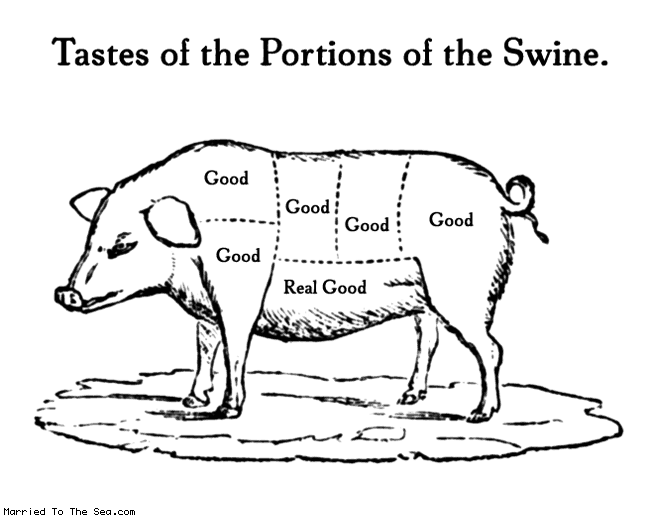
Meat!

So I am persuaded by Mark Bittman's crusade to cut back meat consumption (and his advice for how to do it).

But there is competing evidence. Whom to believe?

Of course, taste and quantity are two separate issues. So maybe the answer is to eat less meat, but eat the Real Good parts when you do. That probably excludes the Genoa salami I bought at Kroger today.

(I know, this is not relevant to field ed or to the election. We'll all get over it.)

11 July 2008

Play time

This morning our Children's Pastor led a training session in the children's teaching method we use with the 1-3 graders. It's called Godly Play. It has been around for a couple decades, and they use it for the kids at Duke Chapel, among other places, but I really didn't know anything about it.

It's a really interesting program in that it structures the whole class time with great intentionality, from the moment each child enters the room (one-by-one, with a personal greeting) until they leave (one-by-one, with an individual blessing). Each week they move the hand on a big clock-like liturgical calendar. The main part of each class is the story, when a storyteller recites (from memory) the Godly Play story for that week. The stories all use unique sets of figurines & props. The stories are written by the Godly Play curriculum, and they are based on either biblical narratives, parables of Jesus, or (occasionally) on more abstract concepts, like "I am the light of the world."

I was really shocked by how theological it is. I really don't know how to relate to children as people, and I have very little concept of what they can understand or remember. But compared with the high-fructose VBS curricula that are out there, Godly Play is just wonderfully solid. It is totally oriented towards creating a reverent, sacred space in the children's classroom. To be honest, the only thing other than church worship that it reminds me of is Mr. Rogers: when the show shifted over to the Neighborhood of Make-Believe, you knew that something special was happening. It's like that.

Anyone else have any experience with this program?

09 July 2008

Is America Ready for a [fill-in-the-blank] President?

Black: sure! Extremely old? Questionable.

A Gallup poll released today indicates that a higher percentage of Americans believe McCain's age will make him a less effective president than believe that Obama's race will make him a less effective president.

I have a hard time believing ageism is more pernicious than racism in this country. On the other hand, ageism is extremely ingrained and often overlooked. In part, it is ingrained and overlooked because it has some limited merit: in general, a person's age does impact his/her capabilities in a way that race does not.

Interestingly, if you scroll down through the poll results, they break it out by candidate preference. McCain supporters pretty much agree with Obama supporters that Obama's race does not impact his effectiveness as president. But 37 percent of Obama supporters believe McCain's age to be a negative factor, compared with only 8 percent of McCain supporters.

What gives? Is this a reasonable judgment to make about a 72 year-old man who wants to take on one of the most taxing jobs in public life? Or do Obama's young, progressive, enlightened supporters have a blind spot when it comes to valuing the elderly?